Have you ever paid good money for a movie ticket, walked into the auditorium, and immediately realized you made a terrible mistake?
You sit down in Row B, only to discover you have to crane your neck backward at an agonizing angle for three hours just to see the subtitles. Or you pick what looks like a "decent middle seat" on a booking app, only to realize the screen is so close and wide that you spend the entire film swiveling your head like you're watching a tennis match.
This happens all the time. And the reason is simple: traditional ticketing platforms show you flat 2D seat grids that lie to you.
CineSeat API Interactive Documentation
The Blind Spot of 2D Seat Maps
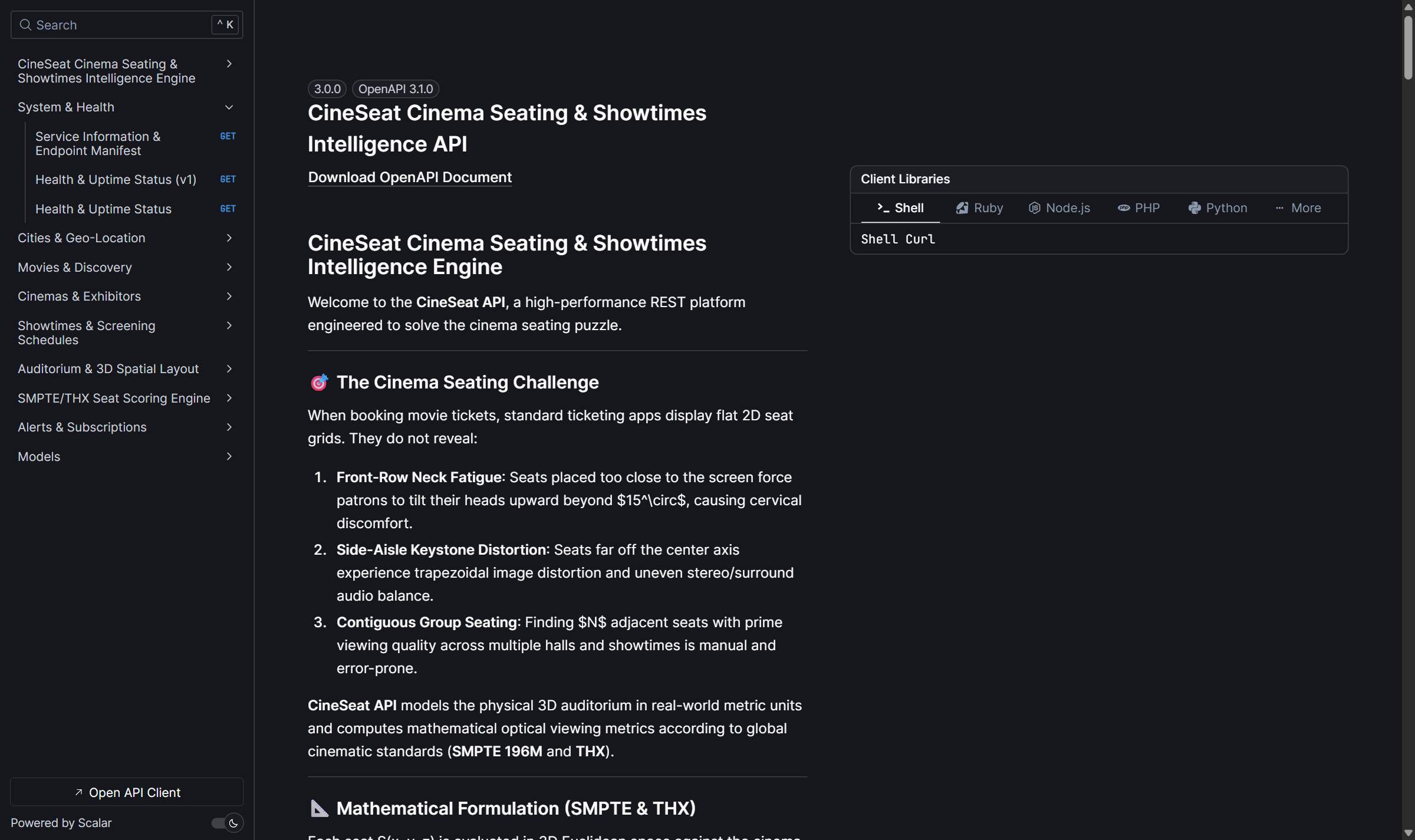
When you book a ticket online, every seat is rendered as an identical little square. At best, seats are color-coded by price category. But a 2D grid completely hides the physical reality of the auditorium:
Vertical Elevation & Neck Strain: Front rows force patrons to tilt their heads upward well beyond comfortable ergonomic limits, causing acute cervical strain.
Screen Keystone Distortion: Extreme side-aisle seats view the screen at a severe oblique angle, causing optical trapezoid distortion and uneven stereo/surround audio balance.
The Sweet Spot Myth: In modern stadium-style cinemas, the "best seat" isn't just about being in the middle of a row—it's about the intersection of optimal field-of-view, screen height, and acoustic staging.
Group Seating Roulette: Booking contiguous seats for friends or family is usually a gamble of guessing which row still has good sightlines left.
I wanted to solve this fundamentally with math, code, and clean architecture. That's why I built CineSeat API.
The Spark: Where's the Developer Solution?
The initial spark for CineSeat came after I discovered seats.movie, created by developer Sunith V S (@sunithvs). He built an impressive consumer tool demonstrating 3D cinema seat previews for moviegoers. It was a really neat project, but as a software engineer, it made me wonder: Why is there no public, developer-friendly solution to this problem?
Whenever developers want to build a movie dashboard, a showtime aggregator, or an indie ticket-booking platform, they hit two major roadblocks:
No unified pan-India movie listings: There was no straightforward, open way to programmatically fetch structured movie schedules, formats (IMAX, 4DX, Atmos), and cinema directories across Indian cities.
No programmatic seat intelligence: Getting the best seat is the most fundamental problem in ticket booking. Instead of forcing developers or users to guess blindly from flat diagrams, developers should be able to integrate real optical seat recommendations directly into their products.
I saw the clear need for an open solution. That's why I engineered CineSeat API from scratch as a standalone, open-source RESTful platform.
What is CineSeat API?
CineSeat API is a high-performance cinema intelligence engine and REST platform designed to evaluate and eliminate bad movie seats.
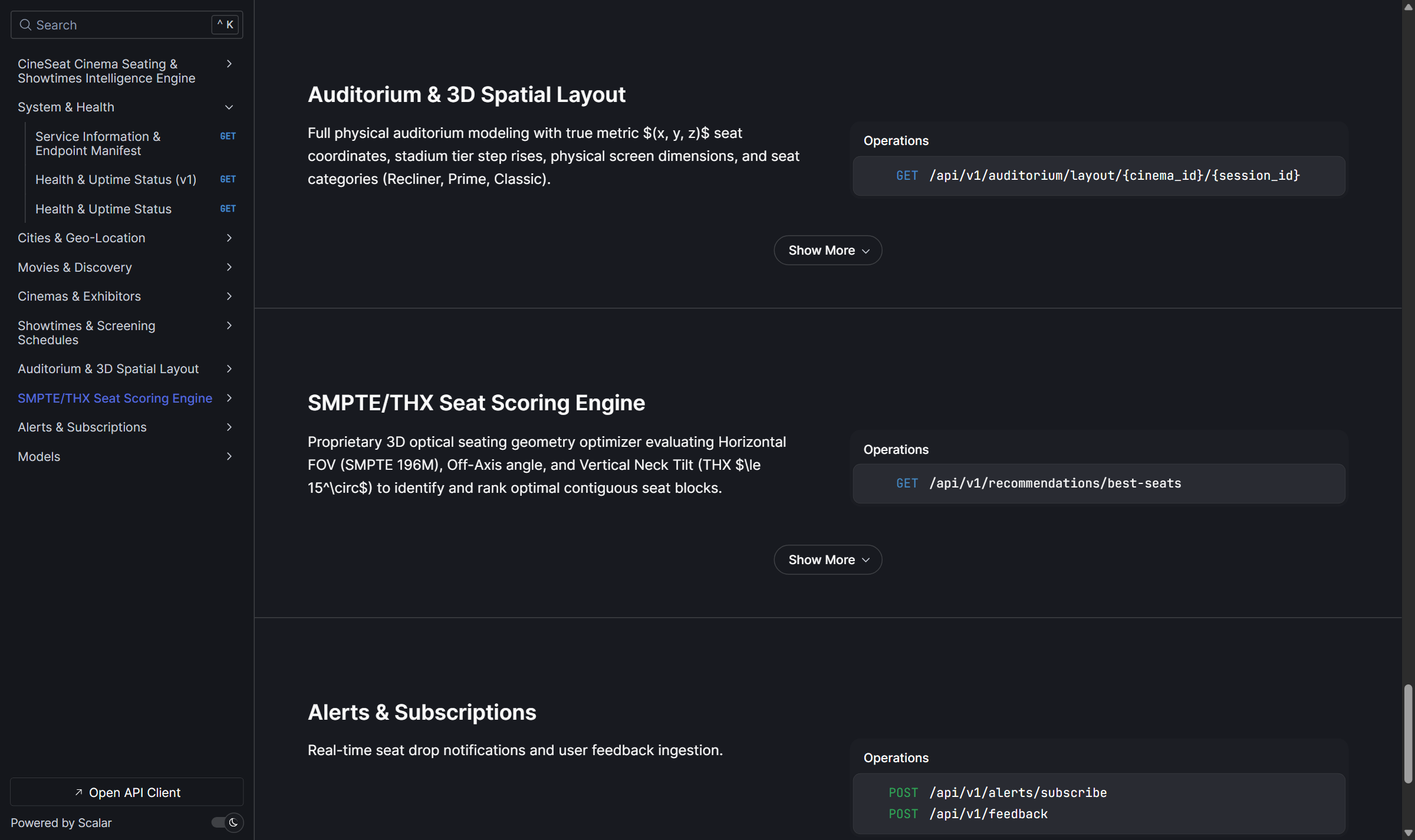
Instead of treating auditoriums as flat tables, CineSeat models the physical hall in real metric units $(x, y, z)$. It accounts for screen width, screen elevation above the floor, tier step rises, and row curve radiuses.
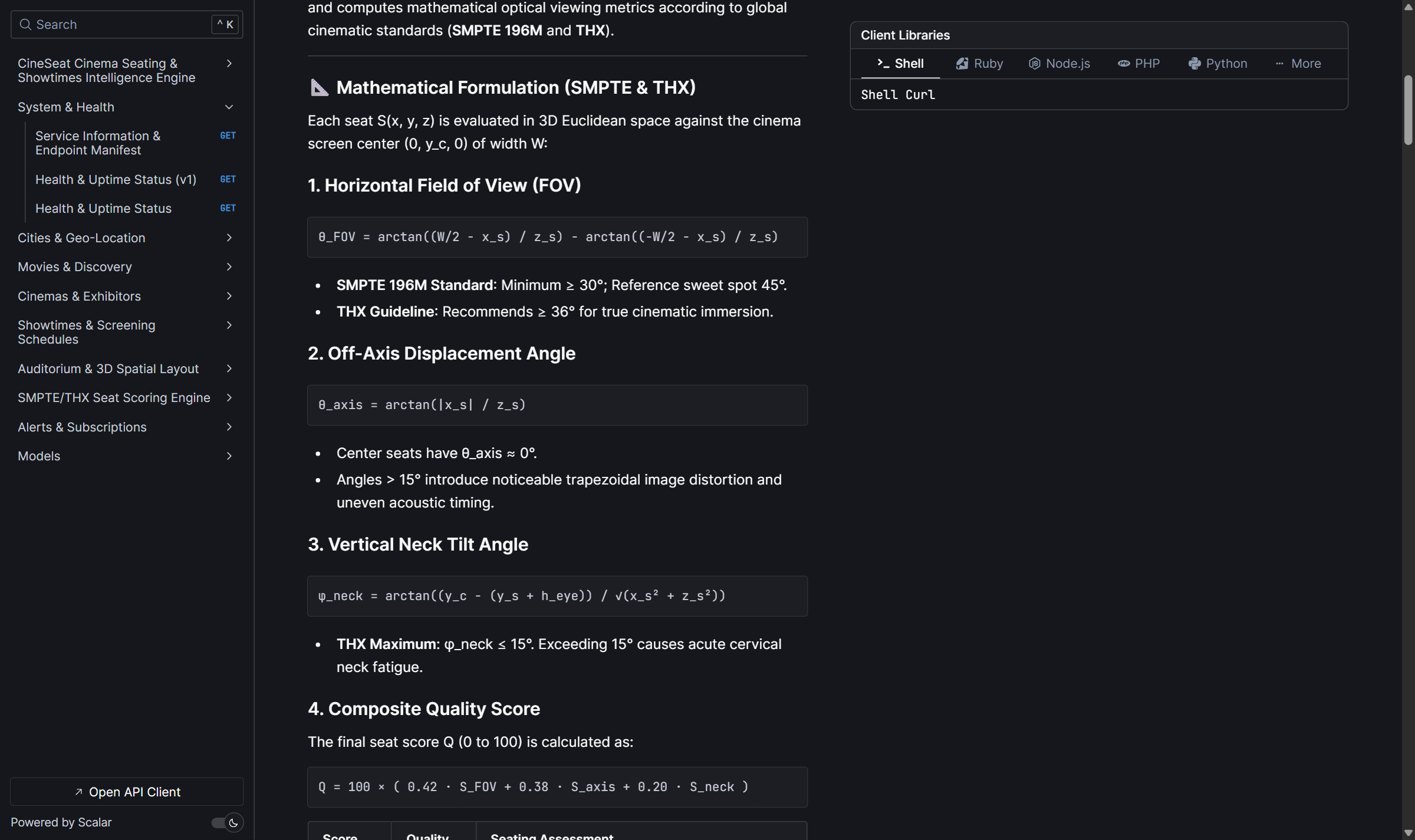
SMPTE and THX Mathematical Formulations
Every seat is empirically scored against global cinematic standards:
1. SMPTE 196M Field of View (FOV)
The Society of Motion Picture and Television Engineers (SMPTE) Standard 196M specifies that the horizontal viewing angle from a seat should span at least 30° of your vision for standard viewing, with 45° representing the ideal cinematic sweet spot. Anything less than 30° feels disconnected and distant; anything over 55° causes visual fatigue.
2. THX Vertical Neck Tilt Protection
THX guidelines mandate that the vertical viewing angle from an audience member's eyes to the top/center of the screen should never exceed 15°. CineSeat calculates this trigonometric angle based on tier elevation and eye height. If a seat forces a tilt beyond 15°, it gets aggressively penalized.
3. Off-Axis Keystoning Mitigation
Watching an IMAX or wide-aspect cinema screen from the far edges introduces severe trapezoidal distortion. CineSeat calculates the angular displacement from the screen's center normal axis, identifying seats that preserve symmetric acoustics and un-distorted visuals.
4. Normalized Composite Quality Score
The engine computes these metrics in single-digit milliseconds and generates a normalized composite quality score from 0 to 100, categorized into:
Reference Sweet Spot (90–100)
Prime Viewing (75–89)
Acceptable (60–74)
Sub-optimal / Neck Strain Warning (Under 60)
Smart Contiguous Group Booking
One of my favorite features in the engine is the contiguous group optimizer. When booking for 2, 4, or 6 people, you shouldn't have to manually check every row to see where the best block remains.
CineSeat uses a sliding-window spatial vector algorithm that scans all available contiguous seats in an auditorium and ranks candidate blocks by aggregated vantage quality, ensuring everyone in the party enjoys an optimal view without anyone being shoved into an extreme corner.
3D Auditorium Layout Spec
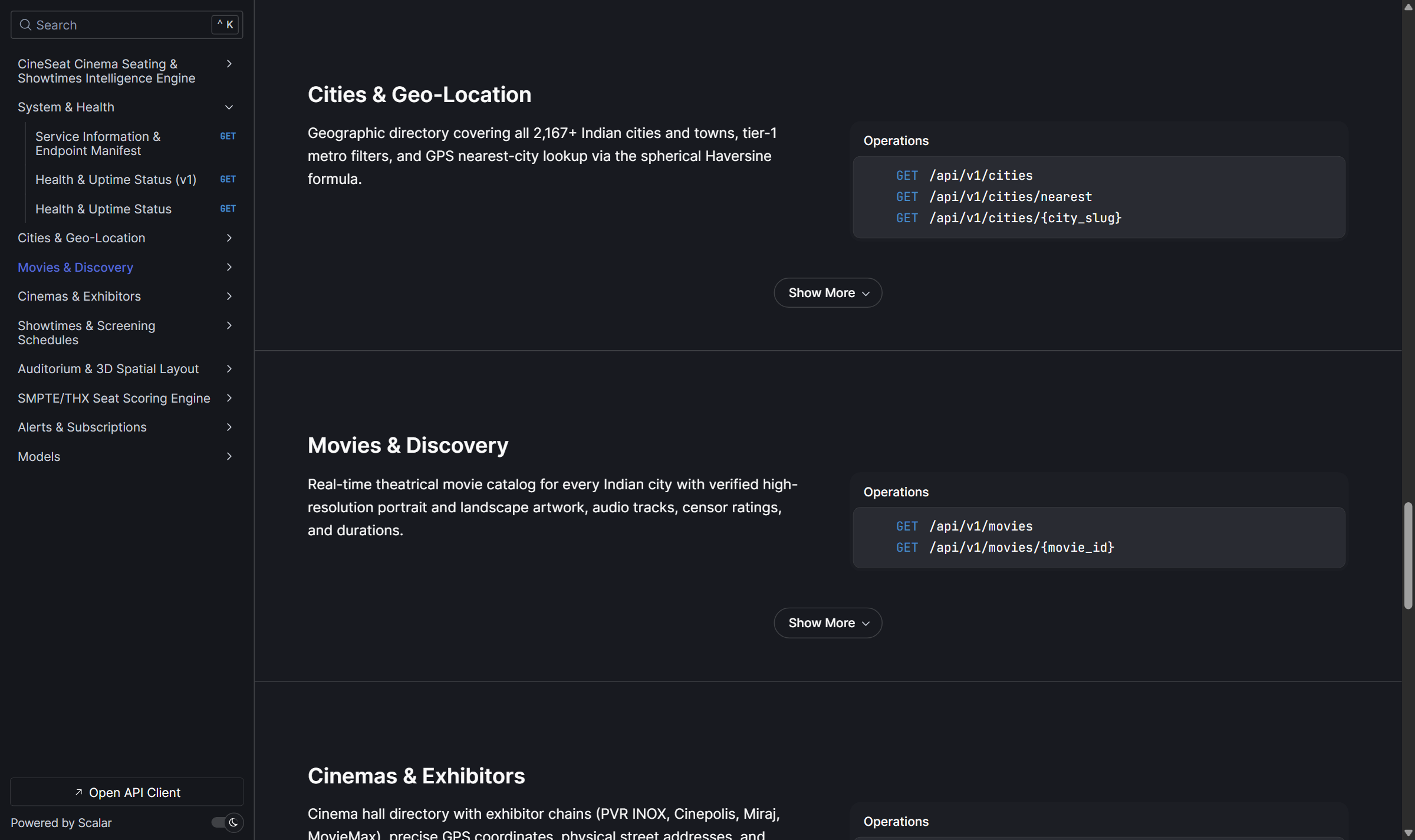
Pan-India Geo-Directory (2,167+ Cities)
Cinema showtimes are meaningless without seamless location intelligence. CineSeat integrates a pan-India geographic index covering 2,167+ cities, towns, and municipalities across all 28 states and union territories.
With the spherical Haversine formula, developers can pass user GPS coordinates (lat, lng) and instantly retrieve the nearest operational cinema hub and its active showtimes.
Pan-India Cities and Geo-Location
The Tech Stack
I wanted the service to be fast, type-safe, developer-friendly, and lightweight:
FastAPI & Python 3.12: Asynchronous request handling, fast startup, and native concurrency.
Pydantic v2: High-throughput validation with compiled Rust internals.
If you're a moviegoer, developer, or cinema enthusiast, I'd love to know what you think! Drop me any thoughts or feature ideas through the Contact page.